Agenda item
Minutes:
The Director of Planning presented the following report:
“1.0 Purpose of Report/Summary of Main Issues
1.1 The report sets out the results of the recent public consultation on the proposed designation of the Belfast City Council area as a holiday designation to enable extended Sunday Trading hours for larger retailers.
2.0 Recommendation
2.1 The Committee is asked to:
· Note the results of the public consultation and additional direct responses received from stakeholders attached as appendices 3-7;
· Note the issues and viewpoints expressed in the course of the public consultation process, as set out in section 3.5; and
· Agree the implementation of the in-principle, council decision from July 2025 and designate the entire Belfast City Council area as a Holiday Resort designation under Article 6, paragraph (9) of the Shops Sunday (Sunday Trading &c.) (Northern Ireland) Order 1997. Any resolution passed by the council on 01 June would take effect from 01 July (i.e. one month after the date on which the resolution may be passed by council).
3.0 Main Report
3.1 At its meeting on 01 July 2025, the Council agreed, in-principle, to progress the Holiday Resort designation citywide under paragraph (9) of the Shops Sunday (Sunday Trading &c.) (Northern Ireland) Order 1997 (‘the legislation’), to be introduced on an ongoing basis commencing March, 2026, following further consultation and engagement with relevant stakeholders, including trade unions.
Designation as a Holiday Resort
Under paragraph (9) of the legislation, a Council may designate ‘any area in its district as a holiday resort’. This means that for 18 Sundays between 1 March and 30 September in any calendar year (apart from Easter Sunday) a large shop which has a relevant floor area exceeding 280 square metres) may open on Sundays in accordance with notice given to Council. Before making any designation, the Order is clear that a Council should consult those likely to be affected by the proposed designation.
The council has consulted on the designation of the city centre as a holiday destination under the legislation on several previous occasions, most recently in 2019-20 but also in 2018 and 2017. On the previous occasions, there was engagement with a broad range of stakeholders including retailers (small and large); trades unions; statutory bodies; cultural sector; families; young people; tourism and hospitality representatives and transport providers.
The issues behind the proposals to designate the city centre as a holiday resort were similar to the current position: ongoing challenges to city centre viability; a desire to accommodate a growing tourism audience and a recognition that there was limited retail and hospitality provision in the city centre on a Sunday morning, compared to other days of the week.
The 1997 Order sets out in paragraph 10 that any resolution to designate a Holiday Resort can only take effect from a specified date, which must be at least one month after the date on which the resolution is passed. Should a decision be taken at this Committee, following due process the specified date on which the decision could take effect would be Sunday 5 July 2026. The extension of Sunday trading hours would therefore run for 13 weeks until Sunday 27 September 2026. The Council will also have to publish a notice of the designation in such a manner as it considers appropriate.
The most recent engagement commenced in April 2025 linked to a Notice of Motion from September 2024 to deliver a pilot Sunday City Animation Project. Council officers held a number of discussions with key stakeholders including management at Victoria Square, Castle Court and the Kennedy Centre, Belfast One, Cathedral Quarter and Linen Quarter BIDs, Belfast Chamber, Retail NI, NI Hotel Federation, Visit Belfast, Translink, USDAW and the Department for Communities. At that time, Shopping Centre management teams were generally supportive of any proposal to extend hours of opening on Sundays, suggesting that retailer buy-in to the proposal shouldn’t be an issue. Views were expressed that flexibility was key for retailers and their workers and that most would probably want to open from 11am onwards rather than anything earlier. The recent engagement and public consultation exercise has confirmed that the positions taken, and views expressed in previous consultations remain relevant.
3.2 Sunday Opening Public Consultation 2026
Following the council decision in July 2025, officers developed an engagement programme to further consult with relevant stakeholders, including trade unions. Crucially this engagement would seek views on the holiday designation being extended across the entire Belfast council area. Officers utilised Your Say Belfast, the council’s engagement platform with created two survey instruments targeting both individuals (residents, visitors and workers) and business responses (all sectors including retailers, business representatives, unions and community organisations). The consultation was launched on Monday 23 March and ran for 7 ½ weeks, closing on Wednesday 13 May. In addition, key stakeholders including trade unions who had previously been engaged in April 2025 were contacted directly to discuss their previously expressed opinions.
The council issued a press release, and the consultation received considerable press coverage over this period. There were over 11,100 visits to the Sunday Openings 2026 webpage on Your Say Belfast. Almost half of these visits were directed via social media, over 80% of which, came from Facebook, with the remainder coming from other platforms including Instagram, LinkedIn and Reddit. In addition, visitors to the page were also directed from the Belfast City Council website, search engine results pages and other media outlets including Belfast Live, the Irish News and the Newsletter.?
In total, there were 5,701 responses to the individual survey and a further 101 responses to the business survey. Additional replies were also received from 5 stakeholder organisations (USDAW, Belfast Chamber, Translink, NI Hotel Federation and Association of Convenience Shops). These are summarised in section 3.6 below and attached as individual appendices.
3.3 Key Findings (Individual Survey)
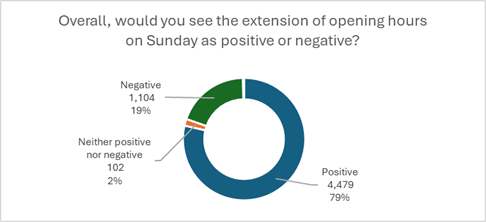
Overall, the majority of (79%) individuals expressed that the extension of Sunday opening hours would be positive, with 19% reporting it as a negative.
|
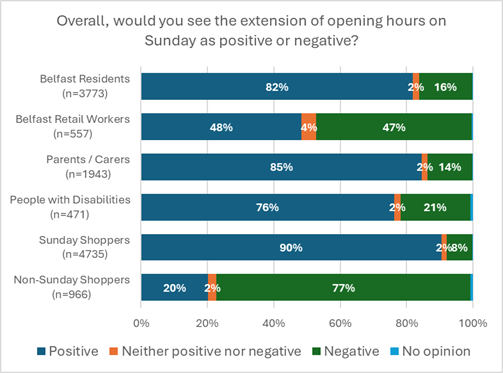
Disaggregation by specific cohorts of interest shows a range of perspectives:
· Belfast residents (82% positive) are in favour of extending Sunday trading hours, by a slightly larger proportion than respondents overall.
· Belfast Retail Workers are divided on the issue, with almost identical numbers of respondents expressing a positive or negative view.
· Those who stated they care for children (parents/carers) and people with disabilities are both heavily in favour of the proposal.
· There is a clear divide in views on the proposal based on whether the respondent currently shops on a Sunday. Those who currently shop on Sundays are 90% positive; whereas those who don’t shop on Sundays are 77% negative.
· Views on the proposal varied by age-group. Those aged 25-40 (86% positive) were most in favour about extending opening hours on Sunday.
· Members of the Roman Catholic community background (91% positive) were most in favour of extending Sunday trading; compared with those from the Protestant community background (64% positive). Those from neither background were also strongly in favour (85% positive).
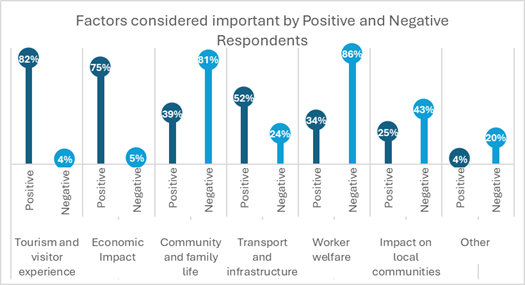
Respondents were asked to identify the factors that the council should consider most, when assessing the proposal to extend Sunday trading hours. They were allowed to pick more than one factor, and most respondents chose to do so. Responses varied depending on whether they saw the overall proposal as positive or negative.
Tourism and Visitor Experience (82%) and Economic Impact (75%) were the most selected factors by positive respondents, conversely, Worker Welfare (86%) and Community and Family Life (81%) were the most selected factors by negative respondents. Negative respondents were most likely to specify ‘Other’ factors, with 20% doing so. Additional factors covered a range of issues including religious observance, comparison of Belfast to other cities, sentiment that existing arrangements were archaic and concern about rest for workers.
Respondents were asked where they thought the ‘holiday resort’ designation should apply, a large majority of respondents (65%) thought that, should the designation occur, it should apply across the entire district, rather than solely for the City Centre. This was consistent with the responses to the 2017 and 2018 consultations.

3.4 Key Findings (Business Survey)
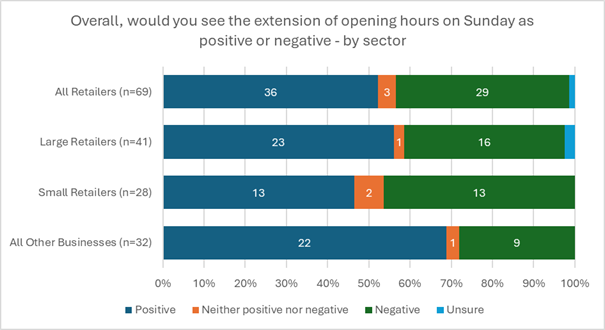
Similarly, a majority (57%) of businesses seen the extension of opening hours on Sundays as a positive with 38% expressing it as a negative. Most retailers (52%) also reported extending Sunday trading hours as positive. A larger proportion of large retailers were in favour, whereas an equal number of smaller retailers reported the extension of opening hours as both positive and negative. A majority of all other businesses (69%) seen it as a positive.
|

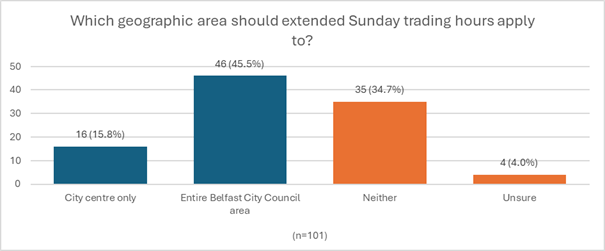
Businesses were also asked which geographic area extended Sunday trading hours should apply to. The entire Belfast City Council area was the most frequent option of responding businesses (46%). Businesses were asked to explain their answer and a selection of responses are listed below:
· ‘Having one rule for city centre and another for surrounding areas seems unnecessary and could be confusing to local patrons and tourists who increasingly stay in and visit wider areas of the city and surrounding countryside.’
· ‘We have premises in North, East, South, West and city centre.’
· ‘Visitors want to explore whole city’
· ‘As this is related to Holiday resort status, the city centre is where the highest % of tourists will be, it is logical, as with other towns throughout NI who have had their councils designate them HRS.’
A detailed feedback report of the public consultation is attached at appendix 1. This includes a further breakdown of the respondents to each survey including crosstabs of results (where appropriate) and a summary of qualitative responses to open-ended questions.
3.5 Main Issues
Tourism and Economic Potential
Should committee agree with the in-principle decision to designate the entire Belfast City Council area as a Holiday Resort designation, large retailers will have the opportunity to extend their Sunday opening hours on 13 Sundays before the end of September as follows:
· July – 5th, 12th, 19th, 26th
· August – 2nd, 9th, 16th, 23rd, 30th
· September – 6th, 13th, 20th, 27th
Analysing the 2026 Belfast Cruise Schedule with the above dates shows that there will be 8 cruise ships docking in the city with approximately 20,000 visitors. Many respondents noted the increase of neighbourhood tourism, highlighting that several tourist attractions and retail offerings are outside of the city centre boundary. This rationale was provided to explain the majority answer to recommend that the entire Belfast City Council area is designated as a holiday designation. Many respondents to the consultation survey highlighted the potential tourism benefits this proposal presents for the city and its neighbourhoods.
Employee Protections
Article 11 and Schedule 2 of the legislation provide employment rights for shop workers, except those contracted to work only on Sundays. They aim to ensure that shop workers are not compelled to work on Sundays against their wishes. The new rights apply irrespective of age, length of service or hours of work. The Schedule provides that dismissal of a shop worker (including dismissal for reasons of redundancy) is unfair if the reason for it was the worker's refusal to work on Sundays. It also provides the right not to suffer any other detriment (such as denial of normal promotion or training opportunities, or refusal to pay seniority bonuses etc) for refusing to work on Sundays. All shop workers employed when the Order came into operation (1997) are automatically eligible for these rights. Those who enter a contract of employment requiring Sunday working after the commencement date will be able to ‘opt out’ of Sunday working subject to giving the employer three months’ notice.
The core protections focus on any Sunday work rather than specific times (e.g., Sunday mornings). If a worker is protected or has opted out, the employer cannot require them to work any part of Sunday, including mornings, without agreement.
Imposing Sunday work could however raise issues if it indirectly discriminates (e.g., on religious grounds), requiring justification and possible reasonable adjustments. Otherwise, there are limited employee protections for retail workers contracted to work solely on Sunday. It should be noted that in the Republic of Ireland, where Sunday trading is effectively deregulated, there is a Code of Practice on Sunday Working in the Retail Trade. The Code promotes best practice for Sunday rostering and compensation, recognising the impact on workers’ quality of life while supporting business needs. It encourages consultation and agreement between employers and employees (or unions), promoting that existing staff should generally volunteer for Sunday work on a rota basis. The Code does not have the force of law, but it is admissible in evidence in proceedings before the Workplace Relations Commission, Labour Court, or civil courts.
As part of the 2018 consultation process, the Council developed a draft Charter (attached at Appendix 2). This Charter sets out a voluntary undertaking for large retailers seeking to operate extended trading hours on designated Sundays.
Should the Committee approve the implementation of the holiday resort designation, the draft Charter will be reviewed and updated in consultation with key stakeholders prior to any application process. This review will be undertaken with specific regard to the Northern Ireland Good Jobs Employment Rights Bill, to encourage retailers not to utilise zero-hours contracts in an exploitative manner when recruiting additional staff for extended Sunday trading.
Religion
Historically, Sunday trading laws in the UK have long reflected religious and cultural traditions, particularly the observance of Sunday as a day of worship and rest for many citizens within the Christian faith. This significance continues to resonate with many citizens, for whom Sunday serves as a vital day for religious practice, family time, and recuperation. The consultation process clearly reflected these concerns. A substantial number of respondents, particularly in response to all open-ended questions, expressed opposition to the proposed extension of Sunday trading hours on religious grounds. Many highlighted the potential erosion of Sunday’s unique status as a day set apart from commercial activity, emphasising its importance for spiritual wellbeing and community cohesion.
3.6 Additional Responses
There were written responses submitted on behalf of five organisations (USDAW, Belfast Chamber, Translink, NI Hotel Federation and Association of Convenience Shops). These are summarised below and attached at Appendices 3-7.
· USDAW - Usdaw’s survey of 220 Belfast retail workers shows strong opposition to extending Sunday trading. 82% view it negatively, with 76% of working parents and carers saying it would negatively impact their family life. Respondents fear increased pressure to work Sundays without additional pay, reduced wellbeing, and harm to work-life balance. They report that their workers would rather be spending time with family and engaging in community, sports and leisure activities or attending church. Usdaw also highlights concerns about negative impacts on smaller retailers (referencing in particular St. George’s Market traders) who can already open and argues there is no clear economic benefit, urging the Council to retain existing arrangements.
· Belfast Chamber – A May 2026 Belfast Chamber member survey of 94 businesses found strong overall support for extending Sunday trading. 66% believe it would benefit business or the city, and 78.7% support opening before 1pm. Most (68.1%) do not anticipate staffing difficulties. Feedback highlights benefits for tourism, footfall, city activity and business flexibility, though a minority raised concerns around staffing pressures, employee wellbeing, and preserving Sunday as a day of rest.
· Translink - while recognising potential benefits of extended Sunday trading, Translink stresses severe funding constraints. Current resources do not allow for extended or enhanced Sunday services across bus and rail networks, and any changes would require dedicated additional funding. Translink therefore takes no position on the proposal but confirms that it lacks capacity to support it operationally at present.
· NI Hotel Federation - the NIHF supports limited extension of Sunday trading hours via holiday resort designation, viewing it as a pragmatic step to boost Belfast’s weekend economy. Current restrictions create a morning activity gap despite strong demand and high Saturday hotel occupancy. Extended hours would enhance the visitor experience, increase dwell time and spending, support hotels, and create a more vibrant, family-friendly city. The flexible, seasonal approach is welcomed as balanced and aligned with tourism needs.
· Association of Convenience Shops - ACS opposes extending Sunday trading hours, arguing there is no unmet consumer need as convenience stores already open freely. The proposal would mainly benefit large supermarkets, displacing trade from independent retailers without increasing overall spending. It also extends beyond the city centre rationale and lacks evidence for supporting high street regeneration. ACS urges the Council to prioritise issues like rates, crime and accessibility instead of changes that could disadvantage small businesses and workers.
· Retail NI - Officers also engaged the Chief Executive of Retail NI, who re-affirmed the organisation’s opposition to any designation of holiday resort designation within the city (particularly at a citywide geography), mirroring previous representations on this issue.
3.7 Animation
There is currently no budget available to deliver a dedicated city-centre, family friendly animation programme on Sunday mornings during any period of extended Sunday trading hours. Staffing resources are also prioritised on the successful delivery of the Fleadh. Nevertheless, there is scope to develop a comprehensive calendar of events highlighting ‘What’s On’ across festivals, events, and activities delivered by both the council and partners funded through CMAG, CFF and the Bank of Ideas.
3.8 Financial and Resource Implications
There are no direct financial implications as a result of this report. Should council designate the entire Belfast City Council area as a Holiday Resort designation, officers from the Place and Economy department will lead the preparations required to enable larger retailer businesses to apply for extended Sunday trading hours. This will include the development of a schedule that will be made available to the public upon request. The Building Control Service currently perform the enforcement role in relation to Sunday trading under the 1997 Order and the designation of the Belfast district as a ‘holiday resort’ would require an additional level of resource to manage the registration of participating shops and enforcement of same.
Equality or Good Relations Implications/Rural Needs Assessment
The decision to designate the entire Belfast City Council area (Sunday Openings 2026) has been subjected to an equality screening and Rural Needs Impact Assessment. The policy has been screened out with identified mitigating actions. These actions include monitoring and evaluation of the impact of extended Sunday opening hours. While the council’s designation will impact future years, elected members do have the opportunity to de-designate the district as a ‘holiday resort’.”
During discussion, the Director highlighted the engagement that had been offered and undertaken with stakeholders.
Proposal
Moved by Councillor Beattie,
Seconded by Councillor de Faoite,
That the Committee:
· Agrees that a Pilot-Scheme be undertaken to designate the entire Belfast City Council area as a Holiday Resort designation under Article 6, paragraph (9) of the Shops Sunday (Sunday Trading &c.) (Northern Ireland) Order 1997 for the two Sundays during the Fleadh Cheoil na hÉireann on 2nd August and 9th August from 11am; and
· Agrees that a timebound Working Group be set-up with relevant stakeholders and trade unions to further engage on the issues, to include consideration of a city centre animation programme and potential alternative activities, funding options and a review of the pilot by the end of October.
Amendment
Moved by Councillor Nelson,
Seconded by Councillor Long,
That the Committee agrees to proceed with the recommendations as outlined in the report.
On a vote, four Members voted for the amendment and sixteen against and it was declared lost.
The original proposal standing in the name of Councillor Beattie and seconded by Councillor de Faoite was put to the meeting when fifteen Members voted for the proposal and five against and it was subsequently declared carried.
Proposal 2
Moved by Councillor Murphy,
Seconded by Councillor Brennan and
Resolved - That the Committee agrees to write to The Executive Office to affirm the Council’s support for the ‘Good Jobs’ Employment Rights Bill and to request that it was progressed as a priority.
Accordingly, the Committee:
· Noted the results of the public consultation and additional direct responses which had been received from stakeholders, attached as appendices 3-7 of the report;
· Noted the issues and viewpoints expressed in the course of the public consultation process, as set out in section 3.5 of the report;
· Agreed that a Pilot-Scheme be undertaken to designate the entire Belfast City Council area as a Holiday Resort designation under Article 6, paragraph (9) of the Shops Sunday (Sunday Trading &c.) (Northern Ireland) Order 1997 for the two Sundays during the Fleadh Cheoil na hÉireann on 2nd August and 9th August from 11am;
· Agreed that a timebound Working Group be set-up with relevant stakeholders and trade unions to further engage on the issues, to include consideration of a city centre animation programme and potential alternative activities, funding options and a review of the pilot by the end of October;
· Noted that any resolution passed by the Council on 1st June, 2026 in relation to the pilot scheme would subsequently require the Council to de-designate the district as a ‘holiday resort’ on completion of the pilot; and
· Agreed to write to The Executive Office to affirm the Council’s support for the ‘Good Jobs’ Employment Rights Bill and to request that it be progressed as a priority.
Supporting documents:
-
SPR - Sunday Openings 2026 Public Consultation v3, item 5c
 PDF 710 KB
 -
Appendix 1 - Sunday Opening Public Consultation Feedback report, item 5c
PDF 2 MB
-
Appendix 2 - Draft Charter, item 5c
PDF 210 KB
-
Appendix 3 - Translink Response, item 5c
PDF 307 KB
-
Appendix 4 - Usdaw response, item 5c
PDF 330 KB
-
Appendix 5 - Belfast Chamber Response, item 5c
PDF 863 KB
-
Appendix 6 - NIHF Response, item 5c
PDF 80 KB
-
Appendix 7 - ACS response, item 5c
PDF 150 KB