Agenda item
Minutes:
The Monitoring, Learning and Reporting Officer presented the following report to the Committee:
“1.0 Purpose of Report or Summary of Main Issues
1.1 To share the information that was submitted to the Department of Agriculture, Environment and Rural Affairs (DAERA) in relation to the Mitigation Report required under the Climate Change Act, Public Body Reporting on the 31st October 2025.
2.0 Recommendations
2.1 The Committee is asked to note that:
i. BCC is required to submit mitigation report to DAERA as part of the public body reporting requirements under the Climate Change Act (Northern Ireland) 2022;
ii. the mitigation report including the amounts and sources of the council's greenhouse gas emissions and a statement of the council’s proposals and policies for reducing those amounts was submitted on the DAERA platform on 31st October 2025 for the baseline year of data (2023/2024);
iii. the council's Scope 1 and 2 emissions for 2023/2024 were 101,42.8 tCO2e and 3565.4 tCO2e respectively;
iv. the council’s proposals and policies for reducing greenhouse gas emissions include the 13 short-term actions within the Climate Action Plan (CAP) that relate to mitigation along with a progress update for each action; and
v. although the next mitigation report to DAERA is not due until 2029, mitigation reporting will be repeated internally on an annual basis to enable Council to track its emissions and its progress for reducing these emissions.
3.0 Main report
3.1 Section 42 of the Climate Change Act (Northern Ireland) 2022 requires DAERA to make new Regulations, which will place climate change reporting duties on specified public bodies. The regulations came into operation in early May 2024, 21 days after they are laid in the Assembly. The first report required under the regulations, is the mitigation report which was submitted on 31st October 2025.
What was submitted?
3.2 As this was the first report, the baseline year of data (2023/2024) of the amounts and sources of the council's greenhouse gas emissions were calculated and uploaded. In future reports the 3 most recent financial years will be required.
3.3 The report also included a statement of the council’s proposals and policies for reducing those amounts and otherwise for mitigating the effects of climate change in the exercise of its functions. On this occasion, this included the short-term actions within the Climate Action Plan (CAP) that relate to mitigation. Updates were included on each of the actions, tracking their target for delivery.
Greenhouse gas figures
3.4 Estimates created inhouse matched those created using the DAERA portal and are listed below.
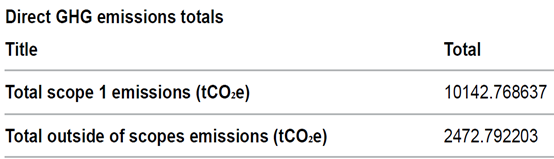 |
Scope 1
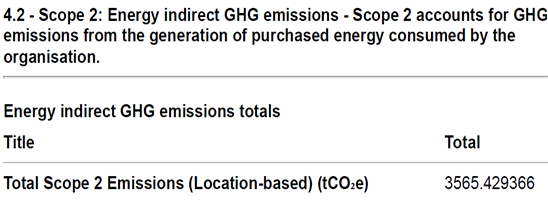 |
Scope 2
Proposals and policies for reduction
3.5 The short-term mitigation actions were submitted to DAERA as our proposals and policies for carbon reduction. The short-term mitigation actions are listed below.
1. Develop and launch an accessible climate data platform to track progress on delivering climate adaptation and mitigation actions (1.7)
2. Develop a sustainable/ low carbon procurement policy and supplier guidance documents to support a transition to an inclusive, net zero and resilient future (1.12)
3. Develop a sustainable food policy for the Council that addresses waste, sourcing, packaging, emissions measurement and an events protocol (1.14)
4. Complete a second phase of building energy audits - (Andersonstown LC, Lisnasharragh LC, Templemore Av LC, Brook LC) and the Waterfront Hall (3.4)
5. Develop the integration of whole life carbon assessments as standard practice in the Capital Programme (3.8)
6. Launch a phased metering and retrofitting programme across BCC’s top energy users based on the findings of the building level audits of Adelaide, Cecil Ward, City Hall and Duncrue (3.11)
7. Scope out a strategy to increase renewable and low-carbon energy use through corporate power purchase agreements (3.15)
8. Review the Business Travel Policy and develop the Sustainable Staff Travel Plan to encourage modal shift, active travel and more fuel-efficient driving for Council staff (4.1)
9. Through sustainable procurement, aim to use local suppliers to the Council to reduce miles travelled within the confines of procurement legislation and Local Govt Act restrictions (4.4)
10. Conduct a commercial assessment of Council land suitable for installing low emission vehicle (LEV) charging points (4.9)
11. Commence work on repurposing staff parking spaces for cycle racks and integrate appropriate facilities to support active travel e.g. shower and changing facilities (4.10)
12. Continue to progress the proposal for a single use plastics policy for the Council (5.4)
13. Develop a mechanism to track and report on internal Council generated waste (5.7).
3.6 There was an additional section that asked about linkage of current action to other existing policies. For example, it was highlighted that an internal sustainable food policy (1.14), will link to current work produced by the Belfast Sustainable Food Partnership.
Next steps
3.7 The next report due to be submitted to DAERA is the adaptation report on 31st March 2026. Further updates will be brought to committee outlining the contents of this report. The Climate Team will continue this mitigation reporting cycle on an annual basis, including figures for our greenhouse gas emissions along with progress made towards actions within the CAP.
4.0 Financial & Resource Implications
4.1 There are no financial and resource implications in relation to this update.
5.0 Equality or Good Relations Implications/Rural Needs Implications
5.1 Any good relations or equality implications will be identified as part of the Council’s screening process.”
The Committee noted the recommendations in the report.
Supporting documents:
-
Update on Public Body Reporting Mitigation report - CCR - Jan 26, item 4.
 PDF 197 KB
 -
Public Body Reporting - Appendix 3 - Mitigation Report, item 4.
PDF 672 KB