Agenda item
Minutes:
The Committee considered the undernoted report:
“1 Relevant Background Information
1.1 This report outlines for Members an approach for establishing the city’s first community plan - the ‘Belfast Agenda’. The paper describes the approach to strategic design; stakeholder inclusion; and outlines the likely engagement processes and interim governance structures that are required to ensure endorsement of the Agenda by Members and our community planning partners by December, 2015.
1.2 Following agreement by Members and our partners, the Belfast Agenda will set out a vision for our city in 2030 and establish a series of related quality of life outcomes for our citizens which will, in effect, constitute the shared long-term strategic plan for the city and its partners. The Agenda will also identify medium term priorities that the Council and its partners are committing to over the next four years if we are to make progress towards achieving our stated long term outcomes.
1.3 There already is a substantial body of evidence, and initial feedback from Members and partners, about what our priorities might be – with a strong emphasis on the need to secure sustainable economic growth for the city as a central driver for achieving longer term outcomes for residents. This emphasis has been supported by our initial engagement; ongoing analysis of the socio-economic data; our analysis of our partners’ plans and strategies; and in feedback from our residents via our recent survey.
1.4 A key aim of the Belfast Agenda will be to turn emerging consensus on the city’s priorities into a series of firm medium term commitments by government departments, agencies, and other relevant stakeholders over the next four years.
1.5 The objectives of this report is to outline for Members consideration a programme of work that will ensure that by December 2015 we have an action-orientated Belfast Agenda that builds on practice, experience and the substantial body of strategic thinking that already exists in the city. At the same time the programme will ensure that we fulfil our statutory obligations as Belfast’s lead community planning partner such as engaging with our partners and residents on the long term vision and outcomes for the city.
1.6 We have an opportunity to be creative and pragmatic in our approach to community planning in ways that allow us to begin to quickly address a number of the city’s key priorities.
2 Key Issues
2.1 The key elements relating to the programme are outlined in the following sections:
1. What are our community planning obligations?
2. Our approach to design the Belfast Agenda
3. The approach to strategic design and engagement
4. Design of governance structures
5. Timeline
6. Initiatives supporting the development of the Agenda
(1) What are our community planning obligations?
2.2 The following is a brief summary of the obligations as described in the draft community planning guidance which is currently out for public consultation. From April 2015 the Council will have a statutory obligation to bring together its partners in the city to lead on the development of the community plan for Belfast. This plan will be the key over-arching strategic framework for all of the city’s stakeholders and will act as a bridge between regional, city and neighbourhood priorities.
2.3 In very broad terms, the plan needs to:
i Create a shared evidence base that is available to all partners (including communities) and which can be used for on-going monitoring and be a basis for measuring our impact.
ii Set out a long a long term vision for the city (up to 2030)
iii Set out a number of related wellbeing outcomes for its residents (up to 2030)
iv Establish partner actions that seek to achieve these outcomes (up to 2020)
2.4 The guidance specifies that we must work with partners to design a process for establishing the vision, the quality of life outcomes and the actions that actively engages stakeholders and residents.
2.5 Belfast will also need a suitable governance structure for agreeing, implementing, monitoring and reviewing the plan. The guidance is not prescriptive in terms of the nature of this structure but it would be led by Members and involve community planning partners. It is also likely that the structure would require some form of representation by business and the community and voluntary sectors.
2.6 Members should note that officers are currently preparing a corporate response to the draft statutory guidance which will be presented to Members in February for approval.
2.7 (2.) Our approach to design the Belfast Agenda
It is proposed that the Agenda will be structured around two levels:
(A) A long term city vision and a series of outcomes for residents (to 2030). This level will set the ambitious long term strategic direction for Belfast. Ideally, any strategic planning process in the city will be able to use these broad outcomes as a reference point. This is also the strategic context for the Local Development Plan. We would agree a series of long term indicators for these outcomes that would help all partners measure the impact of their combined work.
2.8 (B) Our priorities, actions and commitments (to 2020). The second level of the Agenda is about identifying the city’s priorities over the next four year. What are the things the Council and its partners need to focus on now in order to contribute most to the longer term outcomes? And what are the commitments partners need to make in order to address these priorities. These actions will include programmes, strategies and individual interventions. (There will be an emphasis here on joint actions and commitments that would not be possible without the Agenda.) Alongside the actions would be a number of individual performance measures including targets.
2.9 As Members know, it is also important to make progress in developing the Belfast Agenda in this period so that it can influence the next Programme for Government which is also under development.
2.10 (3) The approach to strategic design and engagement
It is proposed that, building on the work to date, the Council will lead a twin-track process to:
a. Establish the long term city vision and a series of outcomes for residents (to 2030); and
b. Establish our priorities, actions and commitments (to 2020) towards achieving these outcomes.
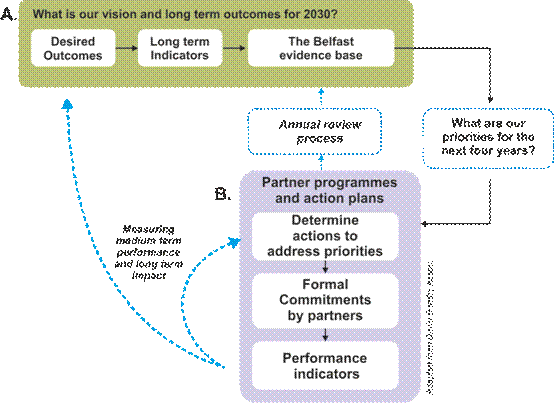
2.11 For Part (A) the Council will set a small design group (drawn from the Council and relevant partners) to draft city outcomes – based on our Plan on a Page; the city evidence base; an audit of city strategies; the results of our residents survey; and the wider knowledge of other partners.
2.12 Members have already been introduced to the work of Mark Friedman and his Outcomes Based Accountability (OBA) approach to planning. The Friedman model seeks to set out a small number of long term outcomes that are supported by a number of indicators that measure how successfully the city is in achieving these outcomes. (This is an approach that’s already been adopted by a number of cities – including Cardiff and Leeds.)
2.13 The Council will hold a ‘Belfast conversation’ on what these outcomes we should have. This would be an inclusive Member-led engagement with a wide range of stakeholders across the city to determine what we want for the city over the longer term. The conversation would include public workshops; online engagement and social media; the use of City Matters and the participation of partners.
2.14 During the same period, the Council will also be working with partners to agree our key priorities and actions for the next four years. The Council hosted a successful initial workshop with a number of key partners on 15 January to consider the initial thinking on priorities. Attended by senior partner representatives the workshop there was broad support for the approach being taken by Members agreement by partners to participate in this process.
2.15 (4) Governance structures
The DoE statutory guidance calls for some form of governance structure for the community planning process. Thinking on governance structures is at a very early stage and will be guided by Members using a ‘form follows function’ approach. The most effective and efficient governance arrangements will need to be influenced by the outcomes, priorities and commitments within the Belfast Agenda.
2.16 A pragmatic governance arrangement will also need to balance a need for inclusivity with effective and timely decision-making. Over time there may be the need for a number of ‘thematic’ sub-groups aligned to individual priorities (for example, around economic growth).
2.17 The final agreed governance structure will need to be agreed by Members and the city’s partners over the next year. Work has now begun to determine the logistical requirements of a community planning structure; accountability and decision-making mechanisms; roles and responsibilities; etc. A further paper will be brought to a future Transformation Committee for discussion.
2.18 (5) Timeline
The target date for a first fully endorsed Belfast Agenda is December 2015. With this date in mind the following high level stages for the delivery of the programme as proposed:
|
Stages |
Key dates |
|
Develop draft vision and city outcomes |
Feb to Apr 15 |
|
The ‘Belfast conversation’ engagement programme |
Feb to April 15 |
|
Train Members, officers and partners in the Outcomes Based Accountability (OBA) |
Feb to Mar 15 |
|
Develop city priorities and partner commitments |
Feb to June 15 |
|
Partners agree draft Belfast Agenda for formal consultation |
From June 2015 |
|
Formal consultation and further refinement |
June to Dec 15
|
|
Endorsement of the Belfast Agenda |
Jan to Mar 16 |
|
Publish the Belfast Agenda |
Apr 2016 |
2.19 (6) Initiatives supporting the development of the Agenda
There are a number of initiatives that are currently in development in support of the approach outlined above. Members are asked to note the following:
2.20 (a) Outcomes Based Accountability (OBA) Capacity programme
As noted above Members have already been introduced to Mark Friedman’s Outcomes Based Accountability (OBA). We will now be rolling out OBA training during February and March with Members and officers. The approach will use real data and real issues to support the development of the draft Belfast Agenda. This training will build our ‘in-house’ capacity to use and develop our own OBA planning processes in the future.
2.21 (b) Building the ‘Smart City’ evidence base
As noted above, one the statutory requirements of the community planning process is for the council to set up and manage an shared ‘evidence base’ which would be available to community planning partners to inform ongoing decision-making on priorities, actions and as a basis for impact measurements. This evidence base would develop over time into a managed resource of smart urban data that would be contributed to by different partners.
2.22 Officers in the community planning team are working to create the initial city baseline (which includes the results of our residents survey and strategic planning audit) and are also pursuing a number of possible routes towards exploring and resourcing a future Smart Cities model.
2.23 (c) Engagement on future Regional Government polices and priorities
As Members will be aware during 2015 the Executive and its departments will be working to establish the next Programme for Government. This is an important time for the Council to make the case for Belfast and to ensure that there is closer alignment between local, city and regional priorities. A key aim of the Belfast Agenda will be to articulate the challenges and opportunities facing the city and to demonstrate a consensus amongst the city’s stakeholders about what Belfast’s priorities should be so that this can inform the new Programme for Government. Initial engagement is beginning to identify areas of importance around the city’s role in attracting inward investment; the need to secure long term economic growth; the importance of our city centre not only for the city but for the entire region; the issue of skills and employability; the need to continue to build on the potential of tourism; and the need to build good relations. The Council, in developing the Belfast Agenda will need to consider its relationship with new and emerging policies and programmes being led by government departments, such as Urban Villages, Social Investment Fund projects and Building Successful Communities.
2.24 One strand of this conversation with regional government is around engagement on the social strand of the Programme for Government. As part of their evidence gathering for this work the Council has been asked by OFMdFM to carry out some early engagement on their behalf during February and March (along with the new Mid-Ulster and Derry City and Strabane district councils) on the social challenges. This engagement programme would then be rolled out to other councils from April onwards.
2.25 In a separate development Community Foundation NI (CFNI) recently offered to facilitate a short engagement programme with a number of ‘hard to reach’ communities on issues of poverty and social inclusion as part of the wider engagement on the Belfast Agenda. Officers are proposing to avail of this offer from CFNI to contribute to the both the Belfast Agenda and the request from OFMdFM to support them in the development of the new regional Social Policy.
3 Resource Implications
3.1 This development phase of the Belfast Agenda is included within departmental resources. The OBA capacity building programme is being supported through the funding allocated for local government reform capacity building.
4 Equality and Good Relations Considerations
4.1 The Belfast Agenda will be developed in line with the Council’s equality and good relations policies.
5 Call In
5.1 This decision is subject to Call In.
6 Recommendations
6.1 The Committee is requested to:
1. note the outline community planning obligations and the intention of Council to make a formal response to the draft statutory guidance
2. consider and agree the broad ‘two-level’ approach to design of the Belfast Agenda and the broad approach to engagement
3. note the approach to the design of governance structures
4. note the proposed timeline and
5. note the initiatives in support of the development of the Agenda”
The Chief Executive reviewed the principal aspects of the report and pointed out that, prior to the meeting, she had received from Mr. B. Marr, who was assisting the Council in developing the Belfast Agenda, the latest draft plan arising from feedback from the Members and from stakeholders. She provided a brief overview of the draft, which set out ideas for outcomes and priorities, and confirmed that the Council would now be identifying actions and targets in order to progress the Belfast Agenda. That process would, for each priority area, involve the establishment of a City stakeholder group and extensive consultation with key stakeholders, including Elected Representatives, external agencies and residents.
After discussion, during which the Chief Executive undertook to forward to the Members a copy of the latest version of the draft plan, the Committee adopted the recommendations.
Supporting documents:
 PDF 286 KB